
Full list of texts
Fifth Estate Collective
Woman Rock Musician
Interview
An interview with Lorraine, of the women’s band GOLDFLOWER, which has played for many enthusiastic women, including Erika Huggins and the other inmates at Niantic State Prison in Connecticut.
Lorraine grew up in a Long Island suburb. At 14, she was playing bluegrass guitar and hanging out with Washington Square folk musicians. At 16 she met a guy named Bobby and married him just before her 17th birthday. They moved to the lower East side where their daughter Magdalena was born. Lorraine left, taking Maggie with her after about a year of marriage. She went through a lot of heavy stuff: unsatisfying relationships, trying to bring her daughter up herself, no money, a brush with hard drugs. A good psychiatrist really helped her a lot. After a while, she felt good enough to start playing guitar again. Singing and playing with Bev and Laura in Goldflower has given her confidence that she lacked even when she was already quite good. But she’s still learning and struggling, doesn’t think of herself as having “made it.” I thought some of the changes she’s gone through in the past couple of years would be meaningful to other women, whether you’re trying to be musicians, or just starting to find out what you’ve always wanted to be.
Sep 10, 2015 Read the whole text...
George Bradford (David Watson)
Woman’s Freedom
Key to the Population Question
a review of
Reproductive Rights and Wrongs by Betsy Hartmann, Harper & Row, New York, 1987; paper $10.95.
This impassioned enquiry is both important and timely. It is important because it synthesizes valuable research to reveal the interlocking connections between world population growth and the related questions of hunger, ecological devastation, political economy, human health and human rights. It is timely because it adds a much-needed dimension to the critique of the Maithusian orthodoxy that overpopulation is the underlying cause of hunger and that population control is the solution. It focuses on the social relations that underlie both the population explosion and the global strategies to confront it, and ties together the discussions of world ecological crisis, the contemporary battle over reproductive rights (including abortion), the question of population control And human rights in the Third World. Much of this is addressed in Lappe and Collins’ book Food First, but by exploring the area of population control, and women’s reproductive and total human rights, Hartmann adds much to the entire discussion.
Aug 7, 2017 Read the whole text...
anon.
Women Demand Rights
Students for a Democratic Society, a radical political organization, held a national convention in Ann Arbor recently during which they adopted a statement demanding equal rights for women, along with statements in opposition to the draft and the war in Vietnam.
The Women’s Liberation Workshop prepared the statement that demanded equal rights, equal positions of authority for competent women, birth control information and devices for all women, and literature on the subject of women’s rights.
Jan 22, 2017 Read the whole text...
Marius Mason
Women Doing Time
a review of
Taking the Rap: Women Doing Time For Society’s Crimes by Ann Hansen. Between the Lines, 2018
When offered the chance to review Ann Hansen’s memoir about her time in the Canadian prison system, I was enthusiastic but doubtful that I would be permitted to receive such a book.
With my Communications Management status and participation in the Rehabilitation Drug Abuse Program (RDAP) while imprisoned at Carswell Federal Medical Center in Texas, it seemed unlikely that this courageous and intensely honest account of real life in all manner of jails, holding facilities, and prisons would be allowed in.
Apr 10, 2019 Read the whole text...
Fifth Estate Collective
Women Hex Prosecutor
Members of the Women’s Liberation Coalition of Michigan staged a protest march in downtown Detroit March 7 to “dramatize the atrocious deaths of our sisters who, in their desperation, have had butcher abortions.”
About fifty women dressed in black with their faces shrouded to symbolize their mourning marched silently through the streets carrying coat hangers, safety pins and other devices often used in illegal abortions. They proceeded to the City Morgue on Brush and Lafayette “where thousands of our murdered sisters have been taken, victims of those who oppose a woman’s right to control her own body and bear the children she wants.”
Jan 18, 2024 Read the whole text...
Shane Perlowin
Women in Black found ‘guilty’ in district court
Asheville, North Carolina, August 6. Ten Asheville women from Women in Black (WIB) found themselves in court on Aug. 6 faced with charges of trespassing. WIB is an international peace network that was started in Israel in 1988 by women protesting against Israel’s occupation of the West Bank and Gaza. They wear black as a symbol of sorrow for all victims of war, for the destruction of people, nature, and the fabric of life.
Nov 9, 2017 Read the whole text...
Dena Clamage
Women in Cuba
Editor’s note: Dena is a Detroit movement activist who went to Cuba in February of this year. She was part of a group of 20 members of Students for a Democratic Society (SDS) who made the trip at the invitation of the Cuban government. This is the fourth article in a series.
The situation regarding the status of the Cuban woman is similar to the situation of black people there. As with black people, women have been integrated into economic and political life of the country, but it has been impossible to completely erase in ten years the scars of centuries of male chauvinism.
Jan 3, 2018 Read the whole text...
Fifth Estate Collective
Women March
In Warren and in Washington
Many women are going to take part in the anti-war activity being planned for the Spring. A group known as the Mayday Coalition is planning a march to the Chrysler Tank Plant in Warren on April 30. Several groups of women are planning to form a contingent named after Angela Davis to be part of the march.
Sep 7, 2015 Read the whole text...
Cindy Felong
Women March on Capitol
“One and a half, two and a half, three and a half, four. You can’t control our bodies anymore!”

“Free our bodies—Free ourselves!” “Hey, Male Chauvinists, you better start shakin’. Today’s Pig is tomorrow’s Bacon!” “Sisterhood is powerful! Sisters Unite!”
Over 2,000 people, mostly women, marched and chanted from Durant Park to the state capitol in Lansing on Saturday, March 13, to demand a change in the state’s abortion laws. Spirits were high and it was clear that for most women there the march was as much a demonstration for women’s liberation as it was for a specific change in the law.
Jul 15, 2025 Read the whole text...
David Adams
Women: Marx’s Forgotten Proletariat
Silvia Federici’s Critique of Marx
While Marx developed some important tools for building a critique of capitalism from the perspective of the worker, he did not devote much thought to capital’s exploitation of women.
In Caliban and the Witch, Silvia Federici critically revisits the transition from feudalism to capitalism, the historical analysis of which plays a significant role in Capital.
Mar 26, 2015 Read the whole text...
Fifth Estate Collective
Women Open Movement Office
The Women’s Liberation Coalition of Michigan has opened a state office in the Ad Hoc building on Woodward, headquarters for several other movement organizations.
The Coalition’s goal is the abolition of male chauvinism—the domination, exploitation, and oppression of women by men.
The office will serve as a center for information exchange between the affiliated women’s groups and the general public. It will also be a coordinating center for the activities of the Coalition.
Nov 10, 2023 Read the whole text...
Nancy Homer
Women Protest Mindless Boob Symbol
Several Detroit women, members of the “Women’s Liberation Movement,” a group of radicals working on their own thing, joined women from New York, New Jersey, Florida, and Iowa in a twelve hour demonstration against the Establishment’s Miss America Contest in Atlantic City, New Jersey, September 7.
Approximately seventy women protested the “mind-less boob symbol” of Miss America behind two police barricades. About 200 hecklers taunted the women, three of the honkies staying for five hours—the cops turned to face the crowd—they were the more violent.
Sep 1, 2015 Read the whole text...
Marieke Bivar
Women’s bodies as capital
Laurie Penny’s essays say women will gain power by saying, “No!” in all spheres
a review of
Meat Market: Female Flesh under Capitalism by Laurie Penny. Zero Books, 2011, 68 pp., $12.95
“Contemporary pseudo-feminism is all about the power of yes. Yes, we want shoes, orgasms and menial office work. Yes, we want chocolate, snuggles, and straight hair. Yes, we will do all the dirty little jobs nobody else wants to do, yes, we will mop and sweep and photocopy and do the shopping and plan the meals and organise the parties and wipe up all the shit and the dirt and grin and strip and perform and straighten our backs and smile and say yes, again yes, we will do it all.”
—from Meat Market
Jul 31, 2016 Read the whole text...
Fifth Estate Collective
Women’s Day
Monday, March 8 was International Women’s Day. Women around the city organized and participated in activities to celebrate that event.
On the previous Saturday women from Youth Against War and Fascism had a literature table at the Lincoln Park Sears industries...
Available from Wayne State Women’s Liberation: the first issue of their magazine Moving Out. Also, a chapbook—a collection of stories, poems, graphics called Free Women: call 577–3409 for info....
Jul 15, 2025 Read the whole text...
Dena Clamage
Women’s Liberation
The Only Path is Revolution
Joyce recently had a baby. She had tried to obtain birth control pills, but couldn’t because of rules which said she had to be married to get a prescription from Planned Parenthood. After discovering that she was pregnant, she attempted to get an abortion, but strict Michigan abortion laws prevented this. Ultimately she married the father of the baby and had a little girl.
Sep 3, 2021 Read the whole text...
Fifth Estate Collective
Various Authors
Women’s Liberation in Cuba
The Federación de Mujeres Cabanas. (Federation of Cuban Women) is the large, popular women’s organization of Cuba. The FMC has an immense responsibility: to untie the “other hand”; to liberate the Cuban women from traditional roles. This means overcoming the traditional prejudices, which in Cuba as in all countries, most especially those of semi-feudal and colonial backgrounds, are deeply ingrained and extremely hard to dislodge. The old crippling “Machismo” mentality must be fought by all revolutionary forces.
Jun 14, 2026 Read the whole text...
Fifth Estate Collective
Women’s News Co-op
A good cigarette is like a woman—the best ones are thin and rich.
If there ever was a time to be a woman, Woman it’s now!
You’ve come a long way Baby—now you’ve even got your own cigarette!
The capitalist media has copped all the rhetoric and jumped on the Women’s Liberation bandwagon. Woman’s newfound freedom has opened up a vast new market of products and ad campaigns-everything from vaginal deodorant sprays to her very own cigarette.
Jul 21, 2022 Read the whole text...
Fifth Estate Collective
Women’s Rights
In a concerted effort to reform the outdated Michigan abortion laws, Michigan Women for Medical Control of Abortion has launched an all-out action program. The program has been set up to involve as many people as possible in working for the medical control of abortion in Michigan.
“Until there is a concerted effort on the part of hundreds of Michigan women, the legislators will not make changes in our abortion laws,” said Mrs. John H. Tanton of Petosky, President of the state organization. Mrs. Tanton pointed out that in a recent test of the old California abortion law, which was similar to Michigan’s, the Supreme Court of that State recently reversed the abortion conviction of a California physician, ruling that the law was invalid “because it infringed on a woman’s right to privacy without legislative reason.”
Sep 6, 2019 Read the whole text...
Fifth Estate Collective
Women’s work is never done
In this column we’d like to share with you some of the work and ideas of women in Detroit. There are many more things to be done, like starting your own rap group, theater group, women’s newspaper, child care center, male baby-sitting service, a women’s union, women’s history classes, auto mechanics and carpentry classes, and women’s legal aid services. How about a women’s center so we can meet each other and coordinate our activities? We need to pool our energies to get some new things started in Detroit. Let us know what you are doing. Maybe we can work together.
Sep 10, 2015 Read the whole text...
Fifth Estate Collective
Women Unite and Fight
Four Michigan women have filed a suit in U.S. District Court charging that the Automatic Retailers of America, Great Lakes Steel Division, discriminate against women by stabilizing them into job categories; in other words, freezing them into dead-end jobs. They also charge that ARA requires women to undergo burdensome training requirements not required for men and deny women equal opportunity to work overtime.
Sep 10, 2015 Read the whole text...
Fifth Estate Collective
Woodstock ad
3 days of Peace & Music
<strong>

Woodstock Music & Art Fair presents</strong>
An Aquarian Exposition
in Wallkill, N.Y.
3 days of Peace & Music
FRI., AUG., 15
Joan Baez
Arlo Guthrie
Tim Hardin
Richie Havens
Incredible String Band
Ravi Shankar
Sweetwater
SAT., AUG., 16
Keef Hartley
Canned Heat
Creedence Clearwater
Grateful Dead
May 7, 2019 Read the whole text...
Peter Gessner
Woodstock Nation
film review
Remember Bevo Francis, sports fans? Well, Abbie Hoffman does.
One of the least off-the-wall sections in “Woodstock Nation,” Abbie’s latest bildungsroman and advertisement for himself (the proceeds are pledged to the Motherfuckers who weren’t in on the Movement’s shakedown of hippie capitalist Woodstock Ventures, Inc.), deals with his visit to the one-horse college where fifteen years ago this Bevo Francis dude was the first human to score 100 points in a basketball game.
Sep 7, 2019 Read the whole text...
Howard Zinn
Words for a New Millennium
To be hopeful in bad times is not just foolishly romantic. It is based on the fact that human history is a history not only of cruelty, but also of compassion, sacrifice, courage, and kindness.
What we choose to emphasize in this complex history will determine our lives. If we see only the worst, it destroys our capacity to do something. If we remember those times and places—and there are so many—where people have behaved so magnificently, this gives us the energy to act, and at least the possibility of sending this spinning top of a world in a different direction.
Nov 26, 2019 Read the whole text...
anon.
Work?!
THISTED, Denmark—Police are looking for a jobless worker who bit off the ear of a labor exchange official and left it wrapped in paper with the handwritten message: “This is your ear.” The victim was Arne Jensen, head of the Koldby labor exchange office near here.
Police identified Jensen’s assailant only as a 34-year-old worker who had been jobless for a long time and repeatedly had refused to take the jobs offered by the labor exchange. Police said he came rushing into the office after Jensen phoned him to say there was a job for him as a farm hand. The man made it clear he did not want that kind of work and then reacted violently at the prospect of losing his unemployment relief.
Feb 26, 2017 Read the whole text...
Michael Desnivic
Work and the Dreamers Against It
The Surrealist movement’s view on what came to be known as work in the 20th Century
a review of
Surrealist Sabotage and the War on Work by Abigail Susik. Manchester University Press, 2021
Surrealism emerged from the brutality of the trenches of the first world war that devastated Europe as an attempt to come to terms with the ruins and a rapidly changing world of new technologies and systems.
May 23, 2022 Read the whole text...
Peter Rachleff
Worker Kills Boss
From Detroit to Springfield and Back
The western Massachusetts area was rocked on Monday, October 10, with the news that a 31 year-old drill press operator at the Springfield American Bosch airplane and truck parts plant had returned from lunch with a .22 caliber rifle and killed a general foreman and critically wounded his immediate foreman.
Jun 10, 2018 Read the whole text...
anon.
Worker Revolts, Political Strife Belie China’s Peaceful Image

Since the struggle for power within the Chinese bureaucracy sharpened following the death of Mao Tse-tung in September, events have begun swirling at an ever faster rate.
Coming on the heels of the political turmoil in the capital city, the startling news that several sections of the country are at the point of armed insurrection certainly lays waste to the myth of China as a peaceful, unified nation -struggling to build socialism.”
Sep 24, 2016 Read the whole text...
David Watson
Workers Aid & the Betrayals of the Left
An introduction
The failure of dissidents in the West to come to terms with the Yugoslav debacle & the subsequent slaughters weighs like a nightmare on the mind & spirit of anyone trying to sort through the complex realities of the present period.
We are publishing Bob Myers’ moving testimony to international solidarity on the eve of the tenth anniversary of the Bosnian genocide (see “Ethnic Cleansing in the Former Yugoslavia” on following page), most of which occurred between the spring and autumn of 1992.
Apr 12, 2021 Read the whole text...
David Gaynes
Workers Battle GE Electric Octopus
147,000 workers at the General Electric Corporation went on strike October 27, 1969. Today, they’re still out of work with little hope of any rapid change in their bleak situation. General Electric’s (non-) negotiators have refused to budge a comma or penny from their pitiful initial offer of a settlement far below the union’s demands.
Jun 18, 2023 Read the whole text...
Fifth Estate Collective
Workers Call For Levi Boycott
“Quack, Quack
I am a duck,
You are probably human
You can wear White Levis
Some people have all the luck”
—The Jefferson Airplane
Some people aren’t so lucky. Strikers against the Levi-Strauss Company in Blue Ridge, Georgia have called for a national boycott of all Levi products.
The strike action was called after 460 of the 570 Strauss workers walked off of the Blue Ridge plant to protest terrible working conditions there. The workers, mostly women, charge that the Strauss plant had located in Blue Ridge in order to exploit the underemployed workers of that region.
Jun 2, 2025 Read the whole text...
Liberation News Service
Workers Feel Squeeze
DETROIT (LNS)—Workers in the automobile industry—described by The New York Times as “among the cream of the nation’s industrial workers”—are feeling the squeeze of rising prices and falling real wages.
Although pay raises have been won regularly from the big automobile giants, the increase in the cost of living has kept real wages down.
Apr 23, 2019 Read the whole text...
Stevphen Shukaitis
Workers’ Inquiry
Militant research and the business school
The autonomist political theorist and strategist Mario Tronti in his classic book Operai e capital argued that weapons for working class revolt have always been taken from the bosses’ arsenal.
At first glance this easily can come off as a kind of hyperbole or even a contradiction. Has not it often been argued, to use feminist writer Audre Lorde’s phrasing, that it is not possible to take apart the master’s house with the master’s tools? Despite the contradictions and tensions contained within his argument, Tronti said this with good reason, for he was writing from a social and historical context where this is just what was taking place. Autonomous politics in Italy emerging at this time greatly benefited from borrowing ideas and methods from bourgeois sociology and social sciences, as well as tools of management theory and industrial relations. And using these tools proceeded to build massive cycles of struggle that vastly changed the grounds of politics in the country and from which people have drawn much inspiration since then.
May 19, 2014 Read the whole text...
National Guardian
Workers Join Students
Reprinted from the Guardian.
San Francisco—A major breakthrough in the San Francisco State College strike was achieved Feb. 7 when representatives of striking workers at the Standard Oil refinery in Richmond, across the Bay, joined with striking SF State students and teachers to call for the formation of a mutual-aid agreement in the best traditions of labor solidarity.
Aug 22, 2021 Read the whole text...
Fifth Estate Collective
Worker’s Letter to Wayne Strikers
One morning last week I was approached at the plant gate after my shift-by a student passing out your handouts. I spoke to him briefly, and noting the peace symbol painted on my lunchbox, he asked me to pass out your sheets in the plant on my lunch break. How can you expect workers to relate to your programs when your people are so uninformed about conditions in the plants they don’t even know a worker can be automatically fired for “distribution of unauthorized literature?”
Jul 17, 2022 Read the whole text...
Fifth Estate Collective
Workers of the world...Relax!
The revolt against work
This was the centerfold of the May 1–7, 1975 (we were a weekly then!) Fifth Estate, as part of a special Mayday supplement. The drawing is by Gilbert Shelton, of “Fabulous, Furry, Freak Brothers” fame.
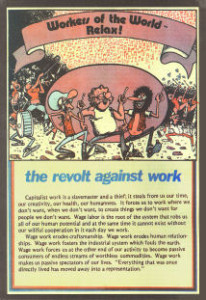
Capitalist work is a slavemaster and a thief; it steals from us our time, our creativity, our health, our humanness. It forces us to work where we don’t want, when we don’t want, to create things we don’t want for people we don’t want. Wage labor is the root of the system that robs us all of our human potential and at the same time it cannot exist without our willful cooperation in it each day we work.
Feb 25, 2014 Read the whole text...
Fredy Perlman
Roger Gregoire
Worker-Student Action Committees (excerpt)
May/June 1968
FE Note: What follows are thoughts on the revolutionary upsurge which shook France 20 years ago. Although ultimately unsuccessful, the message is that revolt is possible in modern society. In ours today, it is not the cops which prevent revolt, but the inertia of what is--the weight of the present.
The introductory section is from the fine new magazine, No Picnic, Spring 1988, Box 69393, Stn. K, Vancouver BC, Canada V5K 4W6; $1.50 per issue. The piece from Fredy Perlman, written from a participant’s viewpoint, appeared in Worker-Student Action Committees, co-authored by R. Gregoire, 1968, $2 from FE Books. The excerpt from Jacques Camatte appeared originally in FE #295, November 3, 1978 and is available at $1. Also recommended is Paris: May 1968, by Solidarity, available from FE Books for $3.
Nov 14, 2020 Read the whole text...
anonymous euonymous
“Workin’ on the Railroad”
Give Chance a Piece
SAN FRANCISCO — On September 5, 1987, an event occurred which may signal a breakthrough for the North American anti-war movement. Forty yards of railroad track and ties serving the Concord Naval Weapons Station (CNWS) in Port Chicago, were torn up by hundreds of protesters during and after a rally at Clyde Park, adjacent to the CNWS.
Jul 30, 2017 Read the whole text...
Hank Malone
Works go Blimp and Gothic, Ltd.
YARGH! STOMP! GIGGLE...WOW!
SLAM! KILK! SIGH...POOT!
RRRRIP! THUD! SPOOOM! AHHHH. BONK! AAAGGHH! MUNCH! CHOFF! HEH, HEH, SPLUT! KLAT! ZZZZZZZZ, HAR, HAR, HEE, HAW, ZNIF! YUMPH!
Gothic Blimp Works is unbelievably good poetry and such (SLAM!)...I mean things is comin’ to life again.
Gothic Blimp Works is the world’s STOMP! STOMP! FLATTEN AND SMASH! And LOVE...ugh...ugh...UGH...UGH. AAAAHHHHHH!
Apr 18, 2019 Read the whole text...
Veronica Lake
World Forums Fighting for Water and Justice
In preparation for the fourth World Social Forum, held in Mumbai, India, January 16–21, a call went out around the world for people to come to Delhi to work out a program of protection for water and water access to be presented to the larger gathering.
Since 2001, the World Social Forum has met to challenge the rules of investment and governance dictated by the corporate World Economic Forum. It proposes democratic, people-centered alternatives to imperialist globalization. Except for this year, it has met in Porto Allegro, Brazil.
Dec 18, 2016 Read the whole text...
Fifth Estate Collective
World Sports Roundup
This issue’s sports roundup shows radical changes in fortune for many players.
Finishing last was Ali Bhutto, former prime minister of the “Islamic Republic” of Pakistan. Despite the pleas of other government leaders around the world, Ali just didn’t make the finals. Calling for leniency in his behalf were such ideological opponents as Leonid Brezhnev and Jimmy Carter, which proves once more that birds of a feather flock together. No matter what their line, politicians in general are not enthusiastic about such precedents being set. To All we can only say, you plays the game—you takes your chances.
Sep 23, 2018 Read the whole text...
Julie Herrada
World War I: The Chicago Trial
“No war but the class war” was the expressed motto of many radicals who refused to enlist or otherwise contribute to any national war effort. At their tenth convention in 1914, the IWW passed a resolution stating, “We as members of the industrial army will refuse to fight for any purpose except the realization of industrial freedom.”
Jun 1, 2015 Read the whole text...
Walker Lane (Peter Werbe)
Worldwide Anarchy
Demonstrations Across the World Oppose Globalized Capitalism
FE note: A quarterly publication cannot hope to keep up with fast breaking events such as the actions that have taken place against capitalist rule over the last year. However, we think it is urgent to report these stories to encourage more such activity, and also, if even belatedly, to counteract the lies posing in the corporate media as news.
Mar 18, 2021 Read the whole text...
Peter Werbe
World-Wide Crisis
Is The Recovery Really Here?
When an economic system produces 32 million unemployed in the industrialized nations, it would almost seem unnecessary to inveigh against its profound inadequacies. But several factors make it worthwhile to look at the present state of disarray in which world capitalism is currently mired.
Although some wag (either a queen, Marx or the Bible) once said that the poor have always been with us, most people know by now that this is a culture-bound observation and no more than a justification for the privilege of society’s wealthy. However, the saying is nonetheless true for the modern world.
Dec 20, 2019 Read the whole text...
Fifth Estate Collective
Would America be better off without Chrysler?
It’s a fair question
You’ve heard it from the pundits, the malcontents, the radicals, even the competition.
Now we’d like to set the record straight.
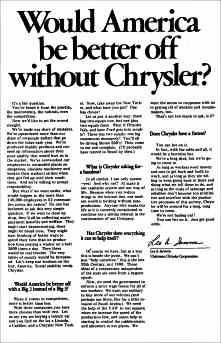
We’ve made our share of mistakes. We’ve squandered more than our share of corporate dollars that go down the tubes each year. We’ve produced shabby products and covered up information about their poor quality that would hurt us in the market. We’ve overworked our employees in outmoded plants on dangerous, obsolete machinery and broken their walkout strikes when they got fed up with their conditions. And we’re willing to accept responsibility.
Nov 24, 2016 Read the whole text...
the Masked Marvel
Wouldn’t it have been nice if...

It must have been like watching one of his own underground movies.
There was Ralph Pickett, manager of the Detroit Repertory Theatre and a friend, Bob, running around in the back woods of Ft. Wayne, Indiana harvesting acres of grass with Sheriff’s deputies lurking down the road waiting to make a bust.
Jun 21, 2017 Read the whole text...
Fifth Estate Collective
Would You Burn A Child?
When Necessary.
Support The Spring Mobilization To End The War In Vietnam.
As members of the Detroit community we declare our opposition to the illegal, immoral, and unconstitutional war being waged against the people of Vietnam. We declare it particularly to the U.S. leaders who bear ultimate responsibility for the outrages being committed in our names. We indict them thusly:
May 17, 2025 Read the whole text...
International Friends of Wei Jingsheng
Would You Let this Man Stand in the Way of Your Bottom Line?
Not if you want to succeed in business today. In the modern international marketplace, competition is tough. If the corporations which have brought us the standard of living we have recently come to enjoy are to continue doing so against an increasing foreign challenge, the killing field must be made level. The only way to do that is to do business with the Peoples’ Republic of China.
Jan 16, 2018 Read the whole text...
anon.
Write-In Candidate for Ann Arbor
Special to the Fifth Estate
Ann Arbor: Elise Boulding of Ann Arbor has begun a write-in campaign for Congress from the Second District of Michigan. The district, which consists of the counties of Washtenaw, Livingston, Lenawee and Monroe, is presently represented in the House of Representatives by Wes Vivian. Vivian has backed the administration’s policy in Vietnam and vacillated on HUAC. His Republican opponent, State Representative Esch, has an equally unimpressive record.
May 4, 2023 Read the whole text...
J.G. Eccarius
Writing an Anarchist Novel
FE Note: The anarchist novel that J.G. Eccarius wrote is The Last Days of Christ the Vampire, excerpts from which appear in the box below. It was first published in 1988 with a second edition featuring a new front and back cover which includes a quote from the Fifth Estate describing Last Days...as “one of the most wildly blasphemous books we have seen since the classics of sacrilege.”
Aug 18, 2019 Read the whole text...
David Porter
Writing on Fire
Passion & obstacles in writing about Emma Goldman in Spain
Studying in Paris during the intense final year (1961 through 1962) of the Algerian war for independence, I became hooked on Algeria and the potentials of revolutionary politics. In 1965 through 1966, I pursued on-site doctoral research on Algeria’s most radical political innovation after independence--a large-scale realm of worked’ self-management in farms, factories and shops throughout the country.
Feb 23, 2015 Read the whole text...
Coco Bonobo
Writings by Emile Armand
Review
a review of
Individualist Anarchism/Revolutionary Sexualism: Writings by Emile Armand. Pallaksch Press 2012 littleblackcart.com/books
This is a nice selected edition of mostly shorter tracts by the French sexpol individualist, Emile Armand (1872–1963). Alejandro De Acosta’s translations are excellent. Most informative are the essays “Life as Experiment,” “The Sexual Fantasists,” and “Revolutionary Sexualism.”
Sep 7, 2018 Read the whole text...
Diane DiPrima
Writings of Diane DiPrima

archangel of fire
enwraps now melts glaciers
turf unexposed
angelic aeons trembles
naked
under a vengeful sun
--Diane DiPrima
August 3, 2002
green shack in Richmond
tag on the door sez “Merlin’s”
just that
--Diane DiPrima
March 23, 2003
Train to Sacramento
true poppies:
Mar 28, 2015 Read the whole text...
Rafael Uzcategui
WSF Caracas: Shroud for Venezuela’s social movements
Excerpt
FE Note: The following is taken from the El Libertario web site. See the above article on this page for their URL.
In the last four years Venezuela has undergone a polarization induced by the top players vying for power: the old “punto fijista” bureaucracy (Fedecamaras, CTV, political parties) against the new Chavez bureaucracy that has supplanted the previous one. This antagonism, false as much as real vs. pretended exercise of power, sustained and amplified by the media, has benefited those who have cast themselves as legitimate voices of the sector of Venezuelan society they claim to represent.
Apr 27, 2015 Read the whole text...
Dena Clamage
WSU Black Workers Move
The League of Revolutionary Black Workers has moved onto the Wayne State University Campus.
In a move to combat racism in employment and bad working conditions, members of the League have organized a group of thirty to forty black secretaries into the Ad Hoc Committee to End Racism, Exploitation and Oppression at Wayne State University.
May 5, 2019 Read the whole text...
Fifth Estate Collective
WSU Jazz Conf.
The second annual Detroit Jazz Conference will be held on Saturday, April 8 and Sunday, April 9 at Wayne State University’s McGregor Memorial Conference Center, the Community Arts Auditorium and the Music Wing.
More than 75 musicians and speakers will participate in the week-end program of live performances, discussions and lecture-demonstrations. Headliners include conference artist -in-residence pianist Cecil Taylor and his quartet, guitarist Kenny Burrell, critic-author A.B. Spellman, and Frank Kofsky, FIFTH ESTATE jazz columnist.
May 18, 2025 Read the whole text...
Fifth Estate Collective
WSU Library Workers Organize
Wayne State University is a working class college in a working class town. It is located in Detroit, a city which has long since taken the United Auto Workers bureaucracy into its ruling class and blunted union militancy by cooptation.
Many of the students of WSU work in Detroit’s factories and belong to unions. Almost all have come into contact with union experience through their parents.
Jun 20, 2022 Read the whole text...
Peggy Cronin
WSU Student Power Movement Growing Fast
After three weeks of exposes, rallies, demonstrations and meetings the Wayne Student Movement last week (May 17–18) elected three candidates to the Wayne Student-Faculty Council. Three additional candidates were elected on modified student power platforms.
The WSM has also been gaining support from the student boards of the various colleges at Wayne. The Liberal Arts Board, the Monteith Council and the School of Social Work Student Organization have endorsed the WSM six demands with qualifications.
May 1, 2022 Read the whole text...
Allen Cohen
WSU Students Battle Again
Wayne University’s complicity with the war effort as well as the manifestation of student-faculty impotency in university policy making were both clearly revealed Nov. 1, when the administration of Wayne State University decided to lodge a marine recruiter on campus.
Following a rally near the south side of State Hall approximately 100 students headed by members of SDS (Students for a Democratic Society), Wayne State University Veterans for Peace in Vietnam and the Detroit Draft Resistance Committee protested the presence on campus of Captain Frank Huey, marine recruiting officer for the area south of Marquette, Mich.
Jan 20, 2023 Read the whole text...
Fifth Estate Collective
W W A D
What Would Anarchists Do?
<em>

Anarchy 101</em>, edited by Dot Matrix, is a crowd-sourced introduction to anarchist ideas. The content comes from the website anarchy101.org, which poses and answers ongoing questions it receives. They represent the best responses from dozens of contributors to hundreds of queries about the “Beautiful Idea: this thing called anarchy,” as Ardent Press, the book’s publisher, puts it. See ardentpress.com.
Jun 24, 2013 Read the whole text...
Peter Werbe
Y2K: Will it all fall apart?
Previous to this era, opponents of capitalism, particularly marxists, but also anarchists, saw the internal contradictions inherent in the political economy as the basis of the system’s overthrow; the working class was to be the agency of revolution. Other marxist theorists postulated that resistance to imperialist domination and colonial oppression, or a revolutionary peasantry, could carry out this task.
Mar 6, 2021 Read the whole text...
anon.
Year of the Bible or Year of the Computer
Choose Your Poison
While Time magazine was announcing the computer as its Man-of-the Year, Ronald Reagan, a former B-movie actor presently in command of the most sophisticated computerized system of annihilation in history, had something else in mind.
Calling Americans “hungry for a spiritual revival,” the President decided to designate 1983 as the Year of the Bible, and told diplomats and politicians at a National Prayer Breakfast that “America will not go forward” without faith in God.
Jul 7, 2015 Read the whole text...
Fred Gardner
Year of the Big Lie
Liberation News Service — Soldiers are shipping out for Vietnam from West Coast embarkation points at a rate that recalls the 1966 build-up—1,700 one day, 3,000 the next. The Oakland Army Terminal is so jammed with GIs on their way to war that hundreds had to sleep out in pup tents during the torrential rains of early January.
Oct 21, 2023 Read the whole text...
John Wilcock
Yellow Submarine
Film review
LONDON The cartoon about the Beatles, “Yellow Submarine” is a watershed movie that could change the pictorial content of all movies and the style of cartoons for all time
Full of puns, (Ringo, rescued by the U.S. Cavalry after being chased by Indians, describes his adventure as “arrowing”), pictorial tricks (clouds patterned like Mexican blankets), thought-provoking jokes (vicious dog with four heads, all pulling different ways) it is a melange of all the commercial and pop art tricks of the past decade.
Aug 21, 2015 Read the whole text...
Fifth Estate Collective
Yes, We Have no Mañanas
U.S. and USSR Prepare for Doomsday
The message relayed by the U.S. Strategic Air Command headquarters’ computer was unmistakable—Soviet missile attack! SAC B-52 bomber engines roared to life, their bomb bays laden with 20-megaton thermonuclear weapons; intercontinental ballistic systems were switched to command function—all that was necessary was the order from the President and the Armageddon of World War Three would commence.
Dec 24, 2018 Read the whole text...
Mary Wildwood
Yikes! We Shut It Down!
Detroit Burner Closes Temporarily
Sometimes we have arguments about whether it is appropriate for anarchist-types to be participating in officially sanctioned political events with double-speak names like “public hearing” held before bogus, paid-off boards with Ministry of Truth names like “Michigan Air Pollution Control Commission.” Like the one held April 17th to validate a backroom deal between the City of Detroit and the Department of Natural Resources (DNR) called a “consent order,” made to allow the Detroit trash incinerator to keep burning even though they couldn’t come up with a test result that didn’t grossly violate emissions standards—standards which consider 79 deaths per million residents an acceptable risk.
Aug 16, 2019 Read the whole text...
Eldridge Cleaver
Jerry Rubin
Stewart E. Albert
Abbie Hoffman
Yipanther Pact
1968—the year of the pig
Reprinted from The Berkeley Barb
The death of the ballot, the birth of the bullet—here is the choice—contemptuously thrust in our face by this decadent racist power structure: racist pig Humphrey, racist pig Nixon, racist pig Wallace for President! So where do we go from here?
Into the streets! Into the alleys! Back of town! Onto the rooftops! Behind whatever shelter remains for a black person here in Babylon!
Aug 8, 2019 Read the whole text...
Fifth Estate Collective
YIP meets in NYC
The virtual vacuum that has been left in the wake of SDS’s floundering may be filled by the New Youth International Party. With repression growing and the need for a national organization crucial, YIP looks promising as a junction for the vast but disparate political energy the movement is developing.
Sep 19, 2019 Read the whole text...
Fifth Estate Collective
Yippies Ready for Chicago Assault
NEW YORK—The Yippies died for a few months this year, partly from under-exposure and partly because, as Abbie Hoffman believes, “the establishment became even more absurd than the idea of YIP.” Hoffman is one of the leaders of the Youth International Party (YIP or Yippies for short).
YIP has renewed its plans for the Chicago Festival of Life conceived last December and forgotten in the mayhem of this year’s politics. The dates of the Festival are August 25–30 and will coincide with Democratic Party Death Convention.
Oct 30, 2018 Read the whole text...
Ron Sakolsky
“Y” Is A Crooked Letter
What kind
of anarch
am I
on my
best days?
The kind
that eludes
the prisons of
“ists” and “isms”
for the
freedom
of the
“Y”.
Why?
That is
the question.
During
my childhood
daze
my mother
dismissed
my incessant
questioning
of her
authority
(my why-ning
as she called it)
with her favorite
parental
pronouncement,
“Y
is a
crooked letter.”
Jul 1, 2014 Read the whole text...
Timothy Leary PhD
You Are a God
...Live Like One
(This column discusses basic “tune in” methods. The next installment suggests harmonious “dropout” methods.)
Psychedelic drugs make it possible to reach a wide range of consciousness. The experienced psychedelic religionist can move consciousness from one level to another, just like focusing a microscope or telescope.
May 1, 2025 Read the whole text...
David Rovics
“You are not welcome in New Zealand, Mr. Rovics.”
Or, the 207th reason why to hate all nation states
It was mid-August, and after singing at various events, mainly ones commemorating the bombing of Hiroshima, I was supposed to be switching planes, en route from Fukuoka to Christchurch, New Zealand, via Tokyo and Auckland. When I got paged over the intercom to the All Nippon Airways desk I was nervous, but figured it was something about a seat assignment on the flight from Narita to Auckland that I was about to board. When the woman from ANA handed me a cell phone and said that someone from New Zealand Immigration in Auckland wanted to talk to me, I was suddenly feeling fatalistic.
Nov 18, 2013 Read the whole text...
Fifth Estate Collective
You Create the Society that Destroys You
It doesn’t take an astute observer to point out that an increasingly important product of our society is death and disease. Neutron bombs, cruise missiles, satellite warfare, radioactive wastes, carcinogenic drinking water, mercury poisoning, chemical plagues, industrially-induced cancers, all are prominent parts of our daily lives.
Jun 21, 2018 Read the whole text...
Bill Rowe
You Gotta Change
A recent addition has been made to the folk scene in the name of John Stewart. He is currently touring key cities to promote his new Capitol album, “California Bloodlines.” The Fifth Estate spoke to him at Baker’s Lounge.
His producer is Nick Venet who has given us such sounds in the past as The Association and The Lovin’ Spoonful.
Apr 14, 2019 Read the whole text...
Sunfrog (Andy “Sunfrog” Smith)
You Might as Well Dance
The Return of the Son of the Layabouts

With a name like the Layabouts, it should come as no surprise that Detroit’s Cass Corridor premier anarchist dance band has taken 15 years to produce a follow-up recording to 1985’s blazing combination of infectious beats and insurrectionary lyrics, No Masters.
Mar 25, 2021 Read the whole text...
Ed Rom
Young Conservatives Vote Against Draft, for Pot
The sphere of politics has gone full-circle with the newly organized Oakland County Chapter of the Young Americans for Freedom.
In the past, YAF has been considered a right-wing, conservative organization. Recently, the Oakland County YAF under the chairmanship of Terry Epton passed resolutions against the draft and against “laws regulating the sale possession and use of marijuana.”
Mar 31, 2017 Read the whole text...
Joe Fineman
“You Only Live Twice” at Palms
Review
When Saturday matinees were only two bits and weekly serials dragged on endlessly, James Bond was barely a flicker on a distant horizon. Broccoli and Saltzman with Panavision, Technicolor, United Artists, Sean Connery and a bottomless shipload of gimmickry have thrown us back to our childhood.
Until now, the most un-cinematic bait drew the fish out of the woodwork; Lesbians, homosexuals, a sadistic grandmother, a unique air corps and a frequently bedridden James Bond. The utter shock of the latest Bond thriller is that it really clears the deck and settles down to telling an exciting story.
Jan 30, 2017 Read the whole text...
Peter Plate
You’re on trial
1979–1981
this courtroom is a public urinal reeking
with the suicidal odor of protocol
the oily horror of boredom illuminates my nausea
on a never ending ride into the hinterlands
of the loneliest chaos I have ever known
does the defendant waive time?
my lawyer winks flirtatiously
yes, your honor
he learned his ABCs
Dec 20, 2019 Read the whole text...
Alan Franklin
Your Money and Your Life
(Part I of a two-part series)
Part II of this article appeared in Fifth Estate #273, June 1976.
The American health care system is currently undergoing a barrage of criticism from every corner; particularly, it has become fair game for dissection on the pages of newspapers all over the country. Last month the Detroit Free Press headlined a front page story “Doctors Blamed for Health Costs,” with a subhead running beneath it which read: “Study Cites Monopoly Fees; Hospital Bills Triple in a Decade.”
Dec 28, 2014 Read the whole text...
Alan Franklin
Your Money and Your Life, Part II
Part I of this article appeared in Fifth Estate #272, May, 1976.
“Horse sense and humanitarianism dictate that we phase out most and probably all municipal hospitals before the end of the century.”
—New York Commissioner of Health Lowell Benin, speaking to a group of businessmen, March 5, 1976.
“We’re going to have to operate pretty much like a private hospital; if a patient can’t pay he won’t be admitted. Patients may have to sell their homes for care. We can’t deprive a student of his education to finance a patient who can’t pay.”
—Chancellor Elmer Learn of the University of California at Davis, on the occasion of the university’s takeover of a public hospital in 1972.
Aug 3, 2015 Read the whole text...
Yevgeny Yevtushenko
You shoot at yourself, America
The color of the Statue of Liberty
Grows ever more deathly pale
As, loving freedom with bullets
You shoot at yourself, America.
You can kill yourself this way!
It is dangerous to go out
Into this hellish world,
But it is still more dangerous
To hide in the bushes
There is a smell on earth of a universal
Apr 6, 2018 Read the whole text...
Fifth Estate Collective
Youth News

The second issue of the Youth News Service was sent out on February 25. The news packet was sent to some 43 high school and youth collectives who are putting out underground newspapers or are thinking of starting them.
The Fifth Estate is turning over a back office to the Youth News Coalition to use as a general Office.
Sep 10, 2015 Read the whole text...
Fifth Estate Collective
Youth News
With the weather warming up, people will be into all kinds of radical activity and crazy shit. If you are into it or see it happening, give us a call at 831–6800 or send it in to us at 4403 Second, Detroit, 48201.
As we go to press, the news just came in that black students at the Orchard Ridge campus of Oakland Community College held a sit-in, trash-in today at the school.
Jul 18, 2025 Read the whole text...
Fifth Estate Collective
Youth Riots
More than 3,000 youths took to the streets over the holiday weekend in Russell Point, a small resort town located next to Indian Lake in Ohio. Pigs moved on the set firing tear gas and shotguns loaded with rock salt. The youths responded with firecrackers, regrouping at different locations each time they were dispersed.
Apr 4, 2026 Read the whole text...
Dan Georgakas
Z — An Interview with Costa-Gavras
NOTE: Costa-Gavras, the director of “Z,” was born in Athens, Greece in 1933. In 1964 he made his first film, “The Sleeping Car Murders” and since has completed “One Man Too Many” and “The Avowal.” While in New York for the opening of “Z,” he was interviewed by Dan Georgakas, a writer who is active in the anti-junta movement, a past contributor to the Fifth Estate who was in Greece in 1963 during the Lambrakis affair, and Gary Crowdus, editor of Cineaste Magazine.
Jul 23, 2022 Read the whole text...
Karen Kovac
Naiomi Epil
‘Zappening (Events Calendar)
The calendar is prepared by Fifth Estate calendar girls Karen Kovac and Naiomi Epil with cooperation from Detroit Adventure. Copy deadline is the 6th and 22nd of each month and should be sent to the Fifth Estate, Calendar 1107 W. Warren, Detroit, Michigan 48201.
SUN OCT 15
DANCE/CONCERT. The Cream plus the Rationals, the Apostles, the Thyme in a no — age — limit show at the Grande Ballroom, Grand River at Beverly from 6 p.m. to 9 p.m. Adm. 10/15.
Dec 1, 2022 Read the whole text...
Don LaCoss
Zapping the Pyramid
Notes on the history of an anti-authoritarian symbol.
The design shows a pyramid surmounted by an eye being blasted by a bolt of lightning. Bannered beneath the collapsing pyramid is the motto, “NON SERVIAM.”
If English, Spanish, Italian, or French is your native tongue, then you can probably guess the Latin translation: “I will not serve.” The phrase is taken from Paradise Lost (1674) by the radical poet of the English Revolution, John Milton, wherein the archangel Lucifer refuses to obey God and is cast into the frozen lake of Hell for his rebelliousness.
Feb 22, 2014 Read the whole text...
Don LaCoss
Zapping the Pyramid
The history of an anti-authoritarian symbol (excerpt)
Excerpted from Fifth Estate #367–368, Spring-Summer 2005 40th anniversary issue. This is an edited version of Don’s essay.
The design shows a pyramid surmounted by an eye being blasted by a bolt of lightning. Bannered beneath the collapsing pyramid is the motto, “NON SERVIAM.”
If English, Spanish, Italian, or French is your native tongue, then you can probably guess the Latin translation: “I will not serve.” The phrase is taken from Paradise Lost (1674) by the radical poet of the English Revolution, John Milton, wherein the archangel Lucifer refuses to obey God and is cast into the frozen lake of Hell for his rebelliousness.
May 14, 2019 Read the whole text...
Max Cafard
Zen Anarchy
Zen anarchy? What could that be? Some new variations on the koans, those classic proto-dadaist Zen “riddles”?
What is the Sound of One Hand making a Clenched Fist?
If you see a Black Flag waving on the Flagpole, what moves?
Does the flag move? Does the wind move?
Does the revolutionary movement move?
What is your original nature--before May ’68, before the Spanish Revolution, before the Paris Commune?
Somehow this doesn’t seem quite right. And in fact, it’s unnecessary. From the beginning, Zen was more anarchic than anarchism. We can take it on its own terms. Just so you don’t think I’m making it all up, I’ll cite some of the greatest and most highly-respected (and respectfully ridiculed) figures in the history of Zen, including Hui-Neng (638–713), the Sixth Patriarch, Lin-Chi (d. 867), the founder of the Rinzai school, Mumon (1183–1260), the Rinzai master who assembled one of the most famous collections of koans, Dogen (1200–1253), the founder of Soto, the second major school, and Hakuin (1685–1768), the great Zen master, poet and artist who revitalized Zen practice.
Mar 14, 2014 Read the whole text...
Kenneth G. Burns
Zen Diet Advocated
Smiling and serene Michio Kushi arrived in Detroit Tuesday, the 31st day of January to talk about his life work, Macrobiotics. To audiences that night at the residence of Bill Reid and Ken Burns and at Jim Semark’s the next, he explained that Macrobiotics is a dietary approach to living based on the principle of yin and yang, two terms for which he has been unable to find an equivalent in our language.
Apr 12, 2025 Read the whole text...
Fifth Estate Collective
Zero Tolerance
No to All Nationalisms!
Ugly nationalism is surfacing everywhere. It is important for those who oppose the State to reject any and all forms it may take. The following addresses the problem in Canada, but applies to all nationalisms.
from A comrade from Quebec, with FE editing
As the orgy of nationalist stupidity approaches its climax, there has never been a better time to reappropriate the word sovereignty. Never has a need for autonomy been more painfully urgent than it is today. But now that Capital and the State occupy almost all the terrain, our minds become the only space that is usually left. The power of the courts, cops, bosses, and bureaucrats of the present and future States is awesome and undeniable. But for us, these institutions have no legitimacy and will have none in the future State.
Jan 22, 2020 Read the whole text...
Peter Rachleff
Zerowork
New Journal reviewed
Zerowork No. 1; Available from P.O. Box 515, Station C, Toronto, Ontario, Canada or through Ammunition Books (see further in this issue).
The last few years have seen the appearance of few new journals, even fewer of which are worth taking seriously. Zerowork, however, is one of the exceptions. Despite a density of text and an absence of graphics and photographs, this journal is well worth reading.
Aug 19, 2016 Read the whole text...
John Zerzan
Zerzan Replies
“If we reach ‘alarming’ conclusions, then we do.”
Bob Brubaker’s defense of agriculture [this issue, FE #330, Winter, 1988–89] seems to have two main components, one in which agriculture itself recedes in favor of “symbolic exchange.” Here it is argued that “symbolism, not agriculture, was the sun around which primitive life revolved,” and that “where there is symbolic interaction with nature, ecological destruction doesn’t take place.” But while it is more pleasant to hear the voices of ceremonials and rituals than to contemplate the ravages of agriculture, reality must also be encountered.
Jan 1, 2021 Read the whole text...
Thomas Metzger
Ziggurat Terminal
Five-legged beast carved in basalt. Face of a Babylonian warlord and body of a desert flesh eater. His eyes saw for centuries into black sand and dust, into the thickened skin of the earth. Cities and cities, temples and temples, mountains of bone above him as a grave. He is a protective godling, seeing forward and seeing nothing.
Jul 17, 2017 Read the whole text...
Len Bracken
Zines as Means for Change
a review of
War of Dreams: A Field Guide to DIY Psy-Ops by Jason Rodgers. PM Press, 2024
At the height of the zine movement in the 1990s, thousands, perhaps tens of thousands—what could be thought of as armies of people—would march off to their post office boxes every day to engage in an ongoing assault on mainstream culture using low-circulation publications as their weapons of choice.
Apr 27, 2025 Read the whole text...
Patrick Flanagan
Zionism and Jewish Ideals
Book review
a review of
The Gun and the Olive Branch: The Roots of Violence in the Middle East by David Hirst. Second Edition, 1984, Faber and Faber, 475 pp., £12.50.
In Mein Weltbild (1934) Albert Einstein identified Judaism with a specific “moral attitude” to life: “the essence of that conception seems to me to lie in an affirmative attitude to the life of all creation. The life of the individual only has meaning insofar as it aids in making the life of every living thing nobler and more beautiful. Life is sacred, that is to say, it is the supreme value, to which all other values are subordinate.” Yet in this same work, the great thinker and lover of peace and human brotherhood defended the Zionist realization of “Judaism” in Palestine
Oct 16, 2020 Read the whole text...
World Revolution
Zionism or Arab Nationalism?
No choice in Mid-East
Today (1973) a new imperialist war breaks out in the Middle East and the vicarious social-patriots who constitute today’s established “left” can hardly contain themselves in their eagerness to rush to the defence of one bourgeoisie against the other.
A few social-democrats and left-wing Zionists declare their solidarity with “plucky little Israel” against “Arab aggression”, ignoring the fact that the state of Israel is fighting a war over conquered territories, over vital raw materials such as the Sinai oil-fields, which now supply almost all of Israel’s oil, over Israel’s “right” to continue her repression and exploitation of thousands of Arab workers and peasants in the “administered areas”.
Dec 21, 2013 Read the whole text...
Liberation News Service
Zionism Past & Present
Anti-Zionism Confused with Anti-Semitism
This short account by Liberation News Service of Zionism’s sordid history as a white settler, colonialist movement barely scratches the surface in terms of the magnitude of the injustices committed in the name of the Jewish people, but should not in any way imply support for any of the Palestinian Nationalist groups who claim to speak for the refugees.
Jan 2, 2014 Read the whole text...
Palestine Book Project
Zionism Victorious
1948: Clearing the land of Palestinians
This article is an excerpt from Our Roots Are Still Alive: The Story of the Palestinian People, by The Peoples Press Palestine Book Project, published by the leftist newspaper The Guardian and is available through the FE Book Service.
[In 1947] The United Nations Special Commission on Palestine (UNSCOP), which had no African or Arab members, recommended by a narrow margin that Palestine be divided into a Jewish and an Arab state. The partition plan granted 55 percent of Palestine to the Jews, who were 30 percent of the population and owned only 6 percent of the land. Some 407,000 Arabs, a number nearly equal to the number of Jews, were to live in the area assigned to the Jewish state. The Arab state was to include ten thousand Jews and 725,000 Arabs in the remaining 45 percent of Palestine.
May 31, 2019 Read the whole text...